Silence used to be polite. In business, it’s now fatal. Customers in 2025 don’t wait hours for a callback or even minutes for an email. They expect answers instantly, on the same screen where they shop, bank, and scroll. And if a company can’t respond? They simply move on to one that can.
That’s why chatbots and conversational AI have shifted from “nice to have” to “mission critical.” Globally, the chatbot market is projected to hit nearly $27 billion by 2030, driven by enterprises realizing the true cost of silence: lost sales, lost loyalty, and lost relevance.
For Kuwaiti businesses, this pressure is even sharper. With internet penetration over 99%, mobile-first consumers, and a rapidly digitizing economy, the ability to engage customers in real time is no longer a differentiator, it’s survival.
Why Delayed Responses Are Bleeding Business
The numbers are blunt:
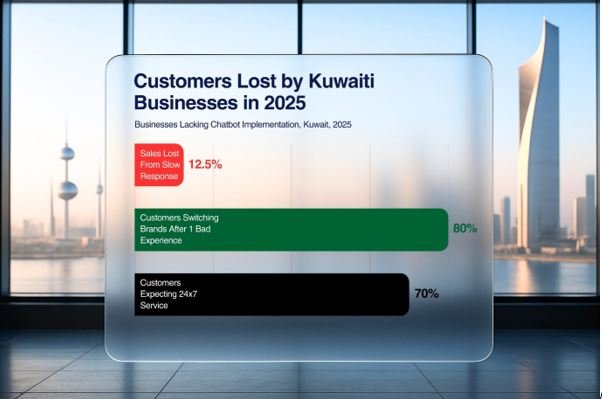
- 70% of consumers expect 24/7 service.
- 80% switch brands after just one bad support experience.
- Businesses that fail to respond quickly lose, on average, 10-15% of potential sales.
Phone lines are expensive. Email feels outdated. Social media is too public to solve problems at scale. That leaves chat: fast, private, scalable, and increasingly intelligent.
In Kuwait’s hyperconnected market, where banking, retail, telecom, and even government services are moving online, companies that don’t integrate chatbots are practically inviting their customers to leave.
Caption: The cost of silence is real: 70% of consumers expect 24/7 service, 80% switch brands after one bad experience, and delayed responses cost 10–15% of sales.
From Support Cost to Growth Engine
The conversation about chatbots used to be framed around “cutting call center costs.” That mindset misses the bigger picture. Modern AI chatbots aren’t just about efficiency, they’re about creating new growth channels.
When deployed strategically, they:
- Guide customers through purchases in real time.
- Handle routine requests instantly, freeing humans for complex cases.
- Integrate across WhatsApp, websites, and mobile apps, ensuring a seamless experience.
For example, a telecom provider can use chatbots to troubleshoot issues before a customer calls. A retailer can recommend products inside a chat window at checkout. A hospital can let patients schedule or reschedule appointments without waiting on hold.
This isn’t customer support. It’s customer engagement at scale.
One example of this shift can be seen in the GCC, where enterprises are already deploying AI-powered chat platforms at scale. DEWA, Dubai’s multibillion dollar leading utility provider, rolled out Smart Response to handle thousands of customer service requests every day. The system doesn’t just deliver instant answers — it continuously learns from customer behaviour, predicting issues before they escalate. By combining automation with human oversight, service levels improved by more than 30 percent while call centre volumes dropped sharply. Behind the scenes, top chatbot developer in Kuwait, Whizkey, built the visual AI elements of Smart Response system, underscoring how regional innovators are setting new global benchmarks for customer engagement.
Why Kuwait Can’t Afford to Lag
The GCC has been pouring billions into digital transformation, but there’s a specific urgency in Kuwait. Consumers here are younger, tech-savvy, and mobile-first. Expectations are unforgiving. A banking client doesn’t want to call back during office hours, they want instant answers at midnight. A retail shopper doesn’t wait for an email reply, they bounce to a competitor offering live chat.
If Kuwaiti businesses hesitate, they risk ceding market share not just to local rivals but also to regional and international players already embedding conversational AI. In this environment, slow adopters won’t just lose customers; they’ll lose entire categories of relevance.
The Players Are Moving Fast
Some enterprises in Kuwait aren’t waiting. They’re deploying advanced chat and agentic AI systems across industries as varied as government, healthcare, retail, telecom, and utilities.
Companies are increasingly turning to regional generational AI experts such as Whizkey, who build and deploy conversational AI solutions designed to handle the unique needs of these sectors. Whether it’s helping citizens navigate e-government portals, assisting patients with healthcare queries, or enabling utilities to manage service requests more efficiently, these solutions are moving chat from the sidelines to the very center of the customer journey.
“Chat isn’t a side channel anymore, it’s where customer trust begins. The organizations moving fastest are those embedding AI agents into their core operations, not treating them as an experiment.” says Rishmeen Chashmawala, VP of Product at Whizkey.
That shift from experiment to essential infrastructure is what will separate tomorrow’s market leaders from laggards.
What Businesses Risk by Staying Silent
Executives often frame chatbot adoption as a question of “timing.” But every month without a chatbot, strategy isn’t neutral, it’s negative. The costs compound:
- Lost sales: Shoppers drop off when questions go unanswered.
- Escalating costs: Human agents can’t scale endlessly.
- Reputation damage: Screenshots of unanswered messages circulate faster than PR teams can react.
And in Kuwait, where competition is heating up across banking, retail, and telecom, silence is more than missed opportunity, it’s brand erosion in real time.
The Next Two Years Will Decide Winners
In 2025, chatbots are still a competitive advantage. By 2027, they’ll be table stakes. Customers won’t be impressed that a company “has a chatbot.” They’ll only notice if it doesn’t.
That means the real competitive edge is timing. Early adopters are already building customer trust, automating interactions, and training their AI systems with valuable data. Latecomers will not only start from behind but face the uphill battle of winning back customers who’ve already switched.
The Bottom Line
The lesson for Kuwaiti businesses is simple: silence is no longer neutral. It’s expensive.
Chatbots aren’t futuristic side projects. They’re the new frontline of customer engagement, the difference between a customer who leaves after 20 seconds of frustration and one who stays loyal for 20 years.
The next great brand battles won’t be fought with billboards or celebrity endorsements. They’ll be fought in chat windows – fast, invisible, and unforgiving.
And in Kuwait, the clock is already ticking.