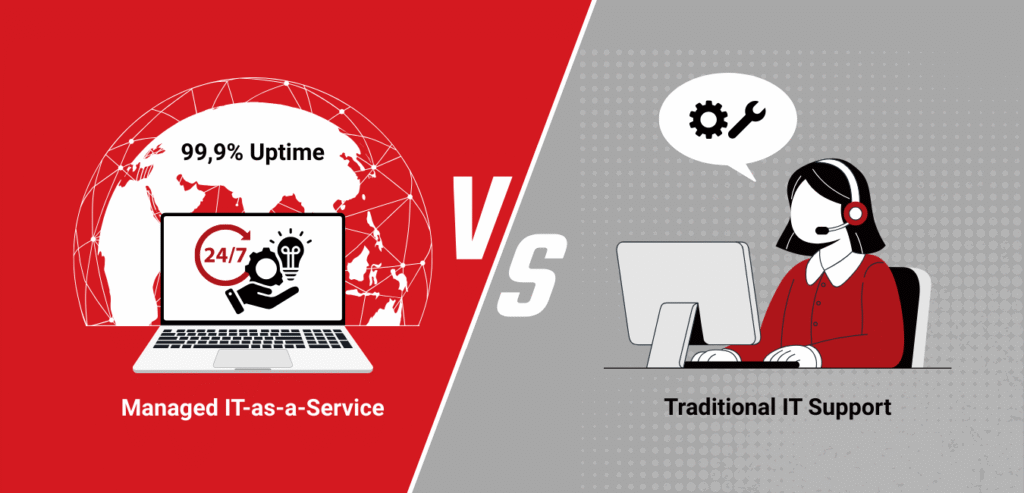
In the past decade, the role of IT has fundamentally changed. It has evolved from a back-office cost center, responsible for fixing printers and managing on-premise servers, to the strategic core of the business. Today, IT drives revenue, customer experience, and innovation. This evolution has created a critical inflection point for business leaders, forcing a choice between two vastly different operational models: traditional in-house IT management and modern Cloud Managed IT Services.
The traditional model is what most businesses grew up with: an in-house team of IT generalists who handle everything. They manage the on-premise server room, respond to desktop support tickets, and manually procure, provision, and maintain all hardware and software. While this model offers a sense of direct control, it is increasingly proving to be slow, expensive, and ill-equipped for the demands of a digital-first world. It is a model defined by large, upfront capital expenditures (CapEx) and a perpetually reactive “break-fix” workflow.
In stark contrast, the Cloud Managed Services model is built for the speed and complexity of the modern cloud era. It involves a strategic partnership with a third-party expert who takes on the 24/7/365 responsibility for managing and optimizing your cloud infrastructure. This approach, offered by specialists like Opsio Cloud, converts your IT costs to a predictable operational expense (OpEx). More importantly, it shifts your IT posture from reactive to proactive, focusing on preventing problems, optimizing costs, and ensuring peak performance.
Deciding between these two models is one of the most important strategic decisions your business will make. Let’s break down the comparison.
Head-to-Head Comparison: Traditional IT vs. Managed Services
| Factor | Traditional IT Management | Cloud Managed IT Services |
| Cost Model | CapEx-Heavy: Requires large, upfront investments in hardware and software. Budgets are lumpy and unpredictable. | OpEx-Driven: A predictable, recurring monthly fee. No upfront capital is needed, freeing up cash for growth. |
| Expertise | Generalist: Relies on a small in-house team that must know “a little about everything.” Hiring specialists is prohibitively expensive. | Specialist: Instant access to a large, certified team of experts in cloud architecture, cybersecurity, FinOps, and data. |
| Operational Stance | Reactive: IT is a “fire department.” The team’s day is spent responding to tickets and fixing things that are already broken. | Proactive: 24/7/365 monitoring detects and resolves issues before they cause downtime. Focus is on prevention and optimization. |
| Security | Basic & Overwhelmed: Security is often one of many tasks for a generalist. Patching is sporadic, and 24/7 monitoring is rare. | Enterprise-Grade: A dedicated security team (SOC) with advanced tools (SIEM/SOAR) provides 24/7 threat detection and response. |
| Scalability | Slow & Rigid: Scaling requires a slow procurement process to buy and install new hardware. Capacity is limited. | Instant & Elastic: Scale resources up or down in minutes to perfectly match business demand. Pay only for what you use. |
| Focus of In-House Team | Maintenance: 80% of the team’s time is spent “keeping the lights on” (patching, backups, support). | Innovation: Frees the in-house team to focus 100% on high-value projects that drive revenue and competitive advantage. |
Which Model Is Right for You?
To make the right choice, you need to be honest about your business goals.
You should stick with Traditional IT Management IF:
- Your business is very small, with extremely simple IT needs (e.g., just email and file sharing).
- You are bound by strict, legacy regulatory requirements that mandate 100% on-premise, air-gapped systems (an increasingly rare scenario).
- Your business has zero plans for digital growth, innovation, or leveraging data analytics.
You should switch to Cloud Managed IT Services IF:
- You are a small, medium, or enterprise-level business that needs to be agile and competitive.
- You want to control and predict your IT spending, moving from CapEx to OpEx.
- You are concerned about cybersecurity and need enterprise-grade, 24/7 protection.
- Your applications are mission-critical and require high availability and peak performance, guaranteed by an SLA.
- You want to liberate your internal IT talent from mundane maintenance and empower them to focus on innovation and growth.
Conclusion: A Choice Between the Past and the Future
The traditional IT model was built for a simpler, slower, and more predictable world. The Cloud Managed IT Services model is designed for the world we live in now: fast, data-driven, and hyper-competitive.
For nearly every organization, the choice is clear. Switching to Cloud Managed Services is no longer just an IT upgrade; it’s a fundamental business upgrade. It reduces risk, controls costs, and—most importantly—unleashes your team’s potential to innovate and win.